
Space Balls®
Unbiased estimation of object length using
virtual sphere probes
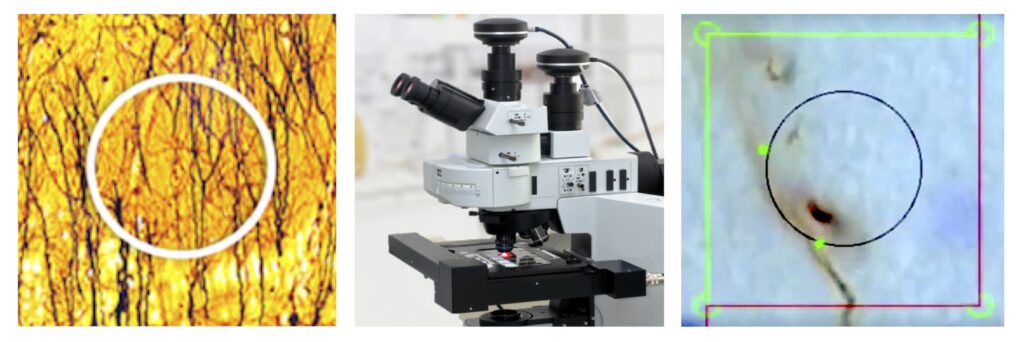
The use of space balls to estimate the length of linear structures such as axons, dendrites, and capillaries, as well as brain hemodynamics, tissue repair, and oxygenation, has become widespread with the increased use of stereology to optimize data collection. [1]
Applying space balls to estimate total length density (Lv) and total L is simple and effective, as it incorporates unbiased fractionator sampling, which is commonly used in neuropathological research.
Functions of Space Balls
In many biological applications, isotropic uniform-random (IUR) and vertical uniform-random (VUR) sampling are used, which makes tissue landmarks difficult to recognize when randomized around one or more axes. This allows the estimation of first-order stereological parameters of anisotropic objects in tissue sections.[1] These methods rely on random intersections between a geometric probe and the object of interest.
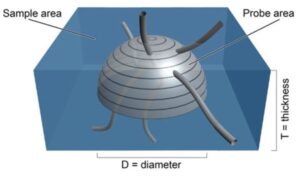
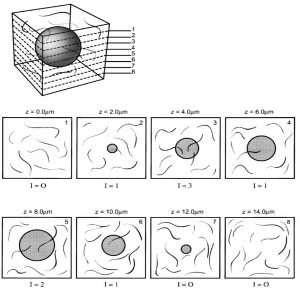
To better estimate length density and total length of linear features in thick tissue sections of any convenient, arbitrary orientation, measurements of intersections are taken between the linear features in the thick sections and virtual test spheres that are uniformly placed within the microstructural space of the thick sections.
The method exploits the isotropic nature of a sphere’s surface to probe linear objects in tissue cut at any orientation.[2]
This approach helps to avoid conflicts related to the corpuscle problem. Furthermore, the use of space balls satisfies the requirement for an isotropic interaction between area probes and linear features such as axons and capillaries.
Works Cited
[1] Mouton, P.R.., Gokhale, A.M., Ward, N.L. and West, M.J. (2002), Stereological length estimation using spherical probes. Journal of Microscopy, 206: 54-64. https://doi.org/10.1046/j.1365-2818.2002.01006.x
[2] West M. J. (2018). Space Balls Revisited: Stereological Estimates of Length With Virtual Isotropic Surface Probes. Frontiers in neuroanatomyhttps://www.ncbi.nlm.nih.gov/pmc/articles/PMC6005839/figure/F1/, 12, 49. https://doi.org/10.3389/fnana.2018.00049
[3] David W. McNeal, PhD, Dieter D. Brandner, BA, Xi Gong, MD, Nadia O. Postupna, PhD, Thomas J. Montine, MD, PhD, C. Dirk Keene, MD, PhD, Stephen A. Back, MD, PhD, Unbiased Stereological Analysis of Reactive Astrogliosis to Estimate Age-Associated Cerebral White Matter Injury, Journal of Neuropathology & Experimental Neurology, Volume 75, Issue 6, June 2016, Pages 539–554, https://doi.org/10.1093/jnen/nlw032